
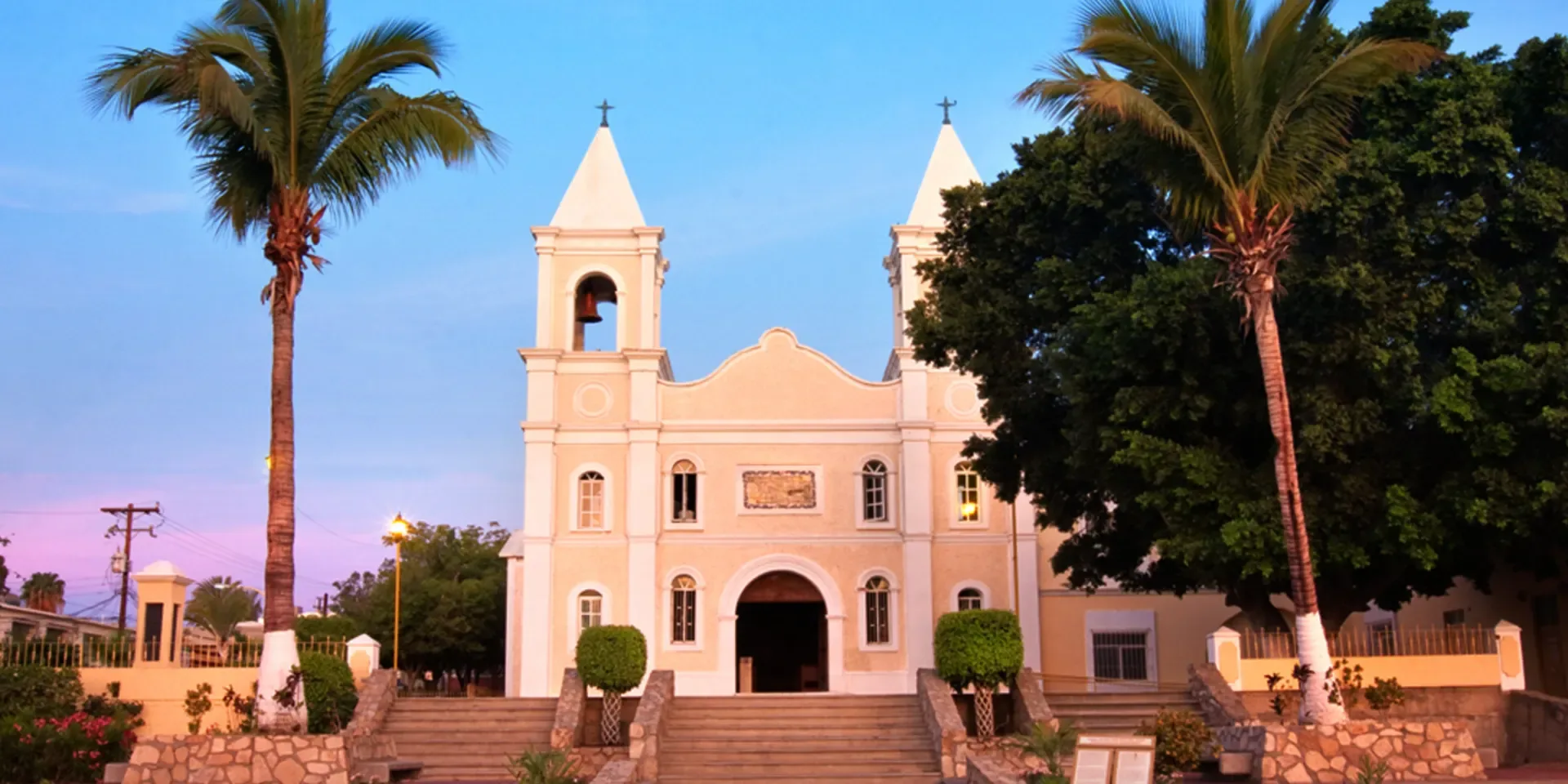
The Mission of San José del Cabo Añuití was the southernmost of the Jesuit missions established during the colonial period of Mexican history in the territory of Old California—corresponding to the current state of Baja California Sur. The mission was dedicated to San José and was built on the site that the Pericúes called Añuití.
This mission was created on April 8, 1730, by Jesuit Nicolás Tamaral and visiting priest José Echeverría. Originally, the mission was established near the beach, next to the estuary of the Origen River, but it was moved much later because the site was considered unhealthy. The mission was endowed by the great benefactor of the Californian missions, the Marquis of Villapuente. Father Tamaral was put in charge of the new foundation, which he successfully launched, baptizing 1,034 Pericúes during his first year.
Towards the end of 1733, the Pericú rebellion began, the strongest in Old California, encompassing all the missions in the far south, including San José del Cabo. Faced with this rebellion, the missionaries requested help from the viceroy of New Spain and the governor of Sinaloa, and although help was sent in the form of a large military contingent, peace did not return until 1737.
In 1750, the indigenous population of this mission was estimated to be 100 individuals. By 1762, it was 63 people; 50 in 1769; and by 1800, it had reached 200. This last increase in the indigenous population was due to the closure of the Santiago mission, whose inhabitants were transferred to San José del Cabo. However, from that year on, the population decline accelerated, so that by 1840 the mission was permanently abandoned due to the disappearance of the Pericú.
Despite the state of decline that the mission experienced in the 19th century, in 1822 it managed to repel an attack by the ship Independencia, which was commanded by Chilean insurgents. During this attack, the mission temple suffered severe damage, leaving it in very poor condition. The current church was built in 1940, and nothing remains of the previous buildings.
Today, it is part of the town of San José del Cabo, in the beautiful municipality of Los Cabos, and as is tradition, celebrations are held in mid-March each year to commemorate the founding of the town and honor this saint.