
…Keep dancing in the mud, my children, there are still many bricks needed to finish the warehouse, and you hurry the oxen along and fix the road so we can bring down the carts with the quarry; we will continue stoking the brick kilns so we can start the vault.…
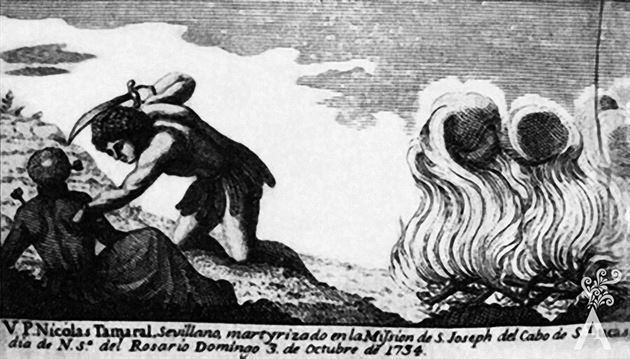
In 1730, Nicolás Tamaral arrived by sea or land at a place on the coast where there was fresh water, an oasis, or a marsh. He looked for a place with the right conditions and found a hill with an impressive view where he decided to establish the mission. In 1734, he was martyred by a rebellion of the indigenous people. The building was destroyed to some extent and abandoned. The region became a place of visitation, meaning that missionaries would occasionally come to celebrate Mass and continue evangelization. The spiritual conquest ended in 1840 with the abandonment of the South Californian missions.
We know from reliable sources that the property where the mission was established, which is now San José Viejo, belonged to the Ceseña family. Around 1840, Don Ramón Ceseña y Talamantes acquired the property to start a family. According to the records held by the parish of San José del Cabo, he married Rosario Castro Ojeda on July 25, 1841, in a ceremony officiated by Fray José Santa Cruz.
The characteristics of this old house can be compared to the architectural elements typical of the missionary establishments of the time, which still remain in those religious buildings in Southern California..
Cloister, on the right side of the temple, with the chapter house, kitchen, stables, bedrooms, library, and a fountain in the center.
Monumental atrium, in front of the temple, consisting of a large esplanade, with a cross usually in the center.
Chapels, so called because processions stopped in front of them, were small porticos that were often built at the four corners of the atrium.
Open chapel, known as the "Indian chapel," commonly located next to the monastic temple, which forms an independent building or is integrated into the cloister.
Don Ramón was born in 1814 and died on October 16, 1901, at the age of 87, according to his death certificate. Six generations have passed through this place, and surely in these more than 150 years, many mysteries will remain in history.
Francisco Ceseña, 77, and Esther Ceseña, 75, siblings who currently live there, cheerfully recount various anecdotes related to the mission.
Francisco tells us: The house on the hill, the house of Don Ramón Ceseña y Talamantes, was built on the foundations of the old mission. The indigenous people were upset, they felt envy, or they did not want to receive the missionaries' teachings. That is how the discord began, and a group of rebels decided to eliminate the missionary. It is not known where they killed him, but it is believed to have been right here. The Indians themselves destroyed the church.
The Jesuit priest Miguel Venegas, in his book Noticias de la California y su conquista temporal y espiritual (News of California and its temporal and spiritual conquest), published in Madrid in 1757, describes...
Father Carranco had sent an escort of neophytes to San José to take Father Tamaral to Santiago, but he refused, and on their return, the emissaries allied themselves with the conspirators... They arrived at the mission on October 1, 1734, and knowing that Father Carranco was alone because the two soldiers had gone to the countryside to bring back two cattle for sacrifice, they entered his room, dragged him out, and killed him with arrows and stones, as well as the boy who served him. When the soldiers who had gone for the cattle arrived, they killed them in the same way. They made a pyre with springs and objects of worship that they took from the church and threw the four bodies into the fire. From there, the rebels went to the Mission of San José, where they arrived on October 3 and killed Father Tamaral in a similar manner to what they had done to Father Carranco in Santiago.
Brother Francisco and Sister Esther comment that their ancestors told them that they had taken part of a gold bell, but that nothing more was ever heard of this piece; they believe that it was given to a doctor of that time.
"I saw the foundation of the mission, measuring approximately 20 by 30 meters, and some other remains of walls on the sides. My grandfather Aarón told us that his father, Don Ramón, probably used that foundation to build the house. It was in 2002 when the house got a concrete roof, but the walls are still the same and are made of adobe bricks," said Francisco.
Ignacio Tirsh, a Jesuit priest from Bohemia, arrived in California in 1761 to join the evangelization efforts in northwestern New Spain. He was interested in the history and reality of the lives of the ancient Californians, drawing what he saw on his constant walks, as the Jesuit was fond of what is now known as natural history. His drawings coincide with the types of buildings such as the house on the hill, and this is another element to consider in the opinion that the original Mission San José was truly built in this location.
On the other hand, in 1769, an expedition to observe the transit of Venus set up camp in a barn located in the ruins of the mission, which, due to its location, is one of the highest points in the region..
The desire for collective and mythological fantasy, as well as the literature that was popular at the time, was largely responsible for the colonization of lands and ports in these areas. They later gave rise to another legend: that this land was untamed, wild and rugged, and could not be conquered. The perfumed land, the land of great mysteries, is a place so wonderful, so enigmatic that even its origin was born from poetry... Land of missions, mysteries, and perfumes.