Historic Center

Our origins in Mexico are found in the Historic Centers and we always return to them. Each generation leaves its mark, for better or worse, on the past, present, and future of the peoples. All, no matter how small, are part of the history of each person, locality, municipality, federal entity, nation, and humanity.

Pericúes People

Pre-Hispanic and Colonial Era

Pericúes People

Pre-Hispanic Pre-Hispanic and Colonial Era

Pericúes People

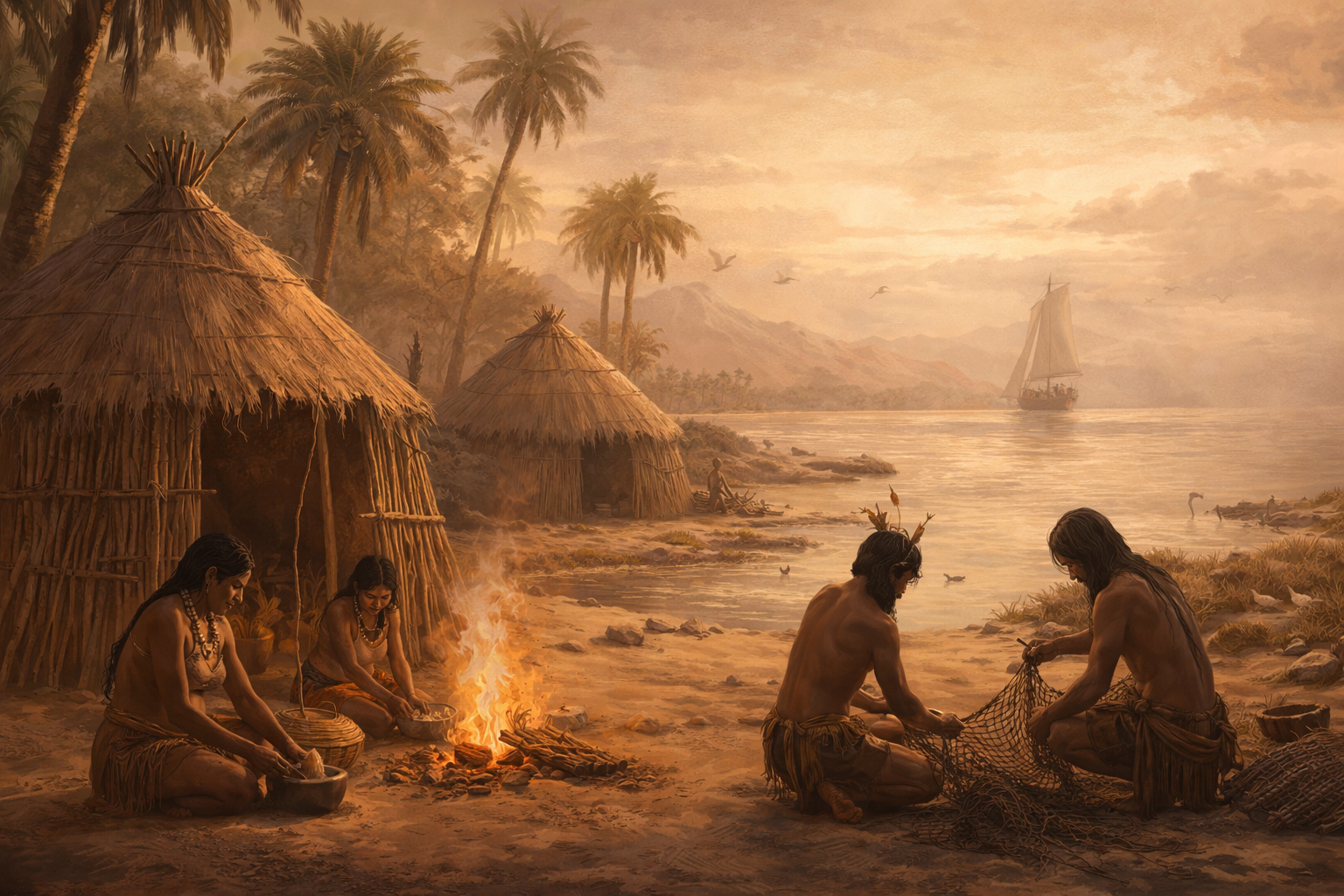
The area was inhabited by the Pericúes, as noted by the Jesuit Miguel del Barco. They relied on the San José Estuary, an oasis teeming with life, rich in birds and fish. By sea they dominated the islands of Cerralvo, San José and Espíritu Santo.

Jesuit missionaries contacted them from 1721 onward and managed to gather them in key places across their territory, where they later founded the missions of Santiago and San José del Cabo. In 1734, these places became the stage of the Pericú Rebellion, which resulted in the martyrdom of missionaries Lorenzo Carranco and Nicolás Tamaral, respectively.

1565+ Pre-Hispanic and Colonial Era

Trade Routes

The estuary and Cabo San Lucas were vital stopovers for the Manila Galleon (Nao de China), where exhausted sailors recovered by eating local fruit such as pitahaya.

The largest trade route began in 1565 with the Manila Galleon, and on this voyage a return route (“tornaviaje”) was made from Acapulco to the Philippines.

In order to stock up on fresh water, galleons stopped in the area of today’s San José Estuary, known at the time as Añuití by the Pericúes and later as Aguada Segura or Bahía de San Bernabé by galleon sailors.

Over time, operating the route demanded a permanent settlement at the tip of California to secure supplies and protection from pirate attacks. However, all colonization attempts failed.

Due to scarce resources and the peninsula’s geographic conditions, the long-held goal of establishing a fixed support point for the Manila Galleon was only achieved on April 8, 1730 with the founding of the Mission of San José del Cabo by Jesuit Nicolás Tamaral and visitor José de Echeverría.

1730 Pre-Hispanic and Colonial Era

Mission Foundation

Jesuit Nicolás Tamaral and visitor José de Echeverría founded the Mission of San José del Cabo Añuití, aiming to secure a safe harbor and convert native peoples despite isolation and scarcity.

1769 Pre-Hispanic and Colonial Era

Astronomical Expedition

French astronomer Jean-Baptiste Chappe d’Auteroche successfully conducted observations at the Mission of San José del Cabo on June 3, 1769, seeking data to calculate the distance between the Earth and the Sun.

Observers across the world joined to watch the transit of Venus across the face of the Sun.

However, due to an epidemic, most members of this Franco-Spanish scientific expedition died, including Chappe d’Auteroche, who was buried at the Mission of San José del Cabo.

1800s 19th Century and the Porfiriato

From Mission to Town: Defense and Progress

A new socio-economic stage began in the first decades of the 19th century. The Pericú population declined drastically, while Spanish immigrants, miners, merchants and sailors settled in the region.

Under these conditions, the mission’s purpose shifted toward agriculture and ranching. By 1824 the region began to function as a town council, and in 1830, by decree of Governor Mariano Monteverde, San José del Cabo changed from mission to town.

During the war between Mexico and the United States (1846–1848), the U.S. Navy invaded and raised its flag over Baja California soil. To defend the territory, the distinguished local figure Mauricio Castro Cota was chosen as political chief of Baja California.

In one clash, on the night of November 19, 1847 in San José del Cabo, a battle began led by Lieutenant José Antonio Mijares, Vicente Mejía and José Matías Moreno against a detachment commanded by Lieutenant Charles Heywood. In that fight in the town center, José Antonio Mijares was gravely wounded and died the next day.

In the second half of the 19th century, San José del Cabo consolidated progress and achieved the status of “villa”. Agriculture—through sugarcane industry and cattle ranching in particular—strengthened maritime trade and coastal shipping, leading to population growth and new social sectors.

During this period, local government implemented public services such as education, postal service, street lighting, security and sanitation.

1904 20th Century and Tourism Development

Clock Tower, Water System and Urban Expansion

Tourism truly took off in the late 1960s, consolidating San José del Cabo as a prominent cultural and natural destination on Mexico’s Pacific coast.

In the first two decades of the 20th century, local society faced droughts, epidemics and devastating hurricanes that toppled buildings.

During the Mexican Revolution, the town was occupied by federal forces until 1914, causing ports to nearly shut down, creating shortages, and interrupting the commercial flow achieved in previous decades.

Despite the economic crisis, the Municipal Palace tower was built and its public clock installed in 1904.

Likewise, a potable water network was installed in 1910 and the urban layout expanded in 1916.

1920–1940 20th Century and Tourism Development

Golden Age and Modernization

From 1920 to 1940, San José del Cabo experienced a golden age, fully entering modernity.

Cattle ranching, agriculture and naval trade regained strength. Roads to La Paz (1920) and to Cabo San Lucas (1927) were put into operation.

The Historic Center recovered its appearance with restorations of the Municipal Palace tower and Teniente Antonio Mijares Plaza, structures damaged by the 1918 hurricane.

In 1925, the business “La Voz del Sur,” located in front of the Municipal Palace, became the country’s second national agency for Ford Models “A” and “T”.

In the 1930s, tomato production and exports to the United States took hold, becoming the main driver of economic development. In the 1940s, this boom declined due to natural disasters, falling tomato prices, and rising maritime freight costs caused by World War II.

Even so, local society pursued progress through construction and the opening of schools and hospitals; in culture and sports, activities like cinema and boxing emerged as forms of recreation.

1952–1956 20th Century and Tourism Development

First Hotels and Sport Fishing

In 1952 the first hotel opened: “Casa O’Fisher,” whose main activity was sport fishing.

In 1956, the Palmilla Hotel began operations, hosting U.S. artists, entrepreneurs and politicians.

1960s 20th Century and Tourism Development

Public Services, Education and Tournaments

In the 1960s, the population of San José del Cabo increased compared to the previous decade.

Public services such as healthcare systems, electricity and potable water improved significantly, as did land communication routes.

Education progressed with the inauguration of facilities for the Antonio Mijares Secondary School.

In tourism, the first sport-fishing tournaments were held at Palmilla and in Cabo San Lucas.

1971–1980 20th Century and Tourism Development

Highway, Airport and Municipality

In 1971, San José del Cabo became a delegation of the Municipality of La Paz.

In 1972 the Benito Juárez Transpeninsular Highway was inaugurated, and in 1977 the San José del Cabo International Airport opened.

In the mid-1970s, FONATUR launched the development project for Los Cabos as an Integrally Planned Center.

On April 8, 1980, during the 250th anniversary of the mission’s founding, the State Congress approved the creation of the Municipality of Los Cabos, making San José del Cabo its municipal seat.

2002 21st Century and International Summits

APEC Summit

In October 2002, Los Cabos hosted the APEC Economic Leaders’ Meeting, bringing together the leading economies of the Asia-Pacific region.

Key topics included economic development and international cooperation, with emphasis on digital policies and trade facilitation.

Representatives from 21 economies participated, with simultaneous committee and ministerial meetings requiring complex logistical coordination.

A digital network was established that significantly improved telephone and internet services, marking a turning point in connectivity.

The event’s scale led hotels to close reservations in advance, allocating room inventory to delegations.

2012 21st Century and International Summits

G20 Summit

In June 2012, the G20 Summit was held in Los Cabos, with 19 countries plus the European Union.

It is a forum for cooperation and consultation on the international financial system, financial stability, and global issues.

It produced outcomes such as the Los Cabos Action Plan (growth, employment and financial stability), IMF strengthening, and agreements against protectionism.

International promotion placed Los Cabos on the world stage, benefiting tourism and the destination’s image.

2014 21st Century and International Summits

Hurricane Odile

After Hurricane Odile devastated infrastructure, a record recovery helped project Los Cabos as a world-class tourism destination.

One year later, hotels, restaurants and services were operating at nearly 100%, with a renewed, improved and modernized image.

Federal and state support, as well as institutional coordination, were recognized for enabling a swift recovery.

Virtuoso awarded Los Cabos “Tourism Board of the Year 2015.”

New hotels and developments opened, while air connectivity and available seats increased.

The hurricane’s impact left lasting lessons in construction practices, social organization and resilience in the face of natural disasters.

2024 21st Century and International Summits

Michelin Stars

Los Cabos appears in the Michelin Guide, with Mexico being evaluated for the first time.

The guide is a key reference for exceptional culinary experiences; earning a Michelin mention can elevate a restaurant’s prestige and international projection.

Los Cabos was selected as one of the evaluated areas, alongside Oaxaca, Baja California, Nuevo León and Mexico City.

The distinction stands out because it represents Michelin’s first official entry into Mexico since the award’s creation.

ES